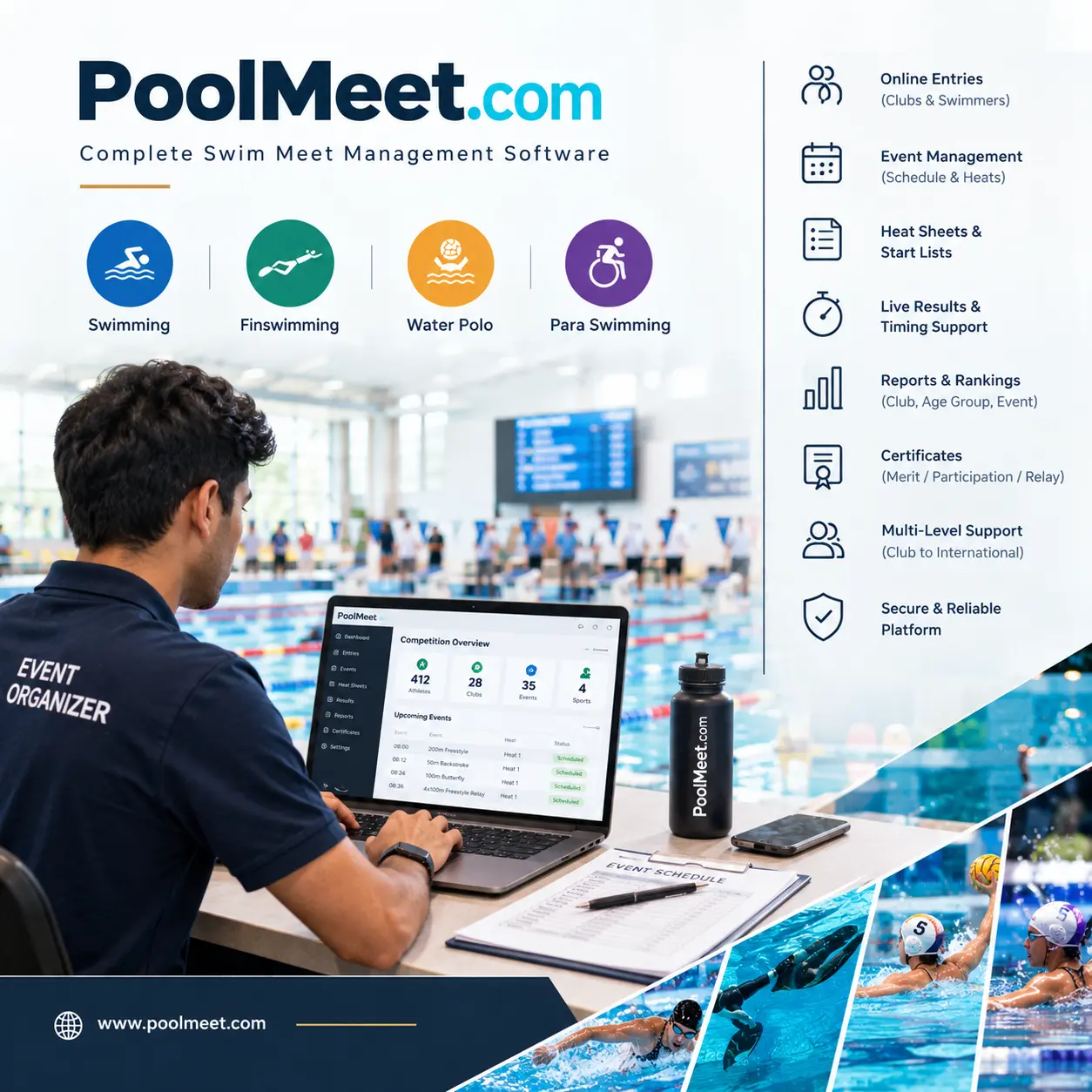
Organizing a swimming competition involves much more than bringing athletes to a pool. Behind every successful meet are hours of planning, coordination, registration, scheduling, communication and result management.
Whether you are organizing a local swimming club competition, a school championship, a district-level meet, a state championship or a major national event, managing the details efficiently is essential to delivering a professional competition experience.
This is where swim meet management software can make a meaningful difference.
Digital competition management tools help organizers bring important competition information into a more organized workflow, reduce repetitive administrative work and improve coordination between clubs, coaches, officials and event administrators.
As aquatic sports continue to develop at different levels, organizers increasingly need flexible ways to manage competitions according to their sport, event format and organizational requirements.
In this guide, we explore what swim meet management software is, why it matters, what organizers should look for when choosing a solution, and how PoolMeet aims to support the wider aquatic sports community.
What Is Swim Meet Management Software?
Swim meet management software is a digital solution designed to help swimming competition organizers plan, coordinate and manage different aspects of a meet.
Depending on the platform and its supported capabilities, it can assist with swimmer registration, club entries, event organization, heat sheets, lane assignments, race timing, results, reports and certificates.
Instead of relying entirely on disconnected documents, spreadsheets, printed lists and manual communication, organizers can use digital tools to bring relevant competition information together.
The objective is straightforward: help organizers manage competition administration more efficiently while allowing coaches, swimmers and officials to focus on their responsibilities.
A suitable swim meet management system can be useful for:
-
Local swimming clubs organizing regular competitions.
-
Schools and academies hosting swimming events.
-
Coaches coordinating entries for their athletes.
-
District and state associations conducting championships.
-
National federations managing large-scale competitions.
-
Event organizers seeking a more structured digital workflow.
The right solution depends on the scale of the event, the sport being organized, the competition rules and the operational requirements of the organizing team.
Why Is Swimming Competition Management Challenging?
Every swimming meet has its own requirements. A small club competition may have a limited number of swimmers and events, while a large championship may involve many clubs, multiple age groups, extensive entries and a demanding competition schedule.
Regardless of size, organizers often face several common challenges.
1. Managing Entries from Multiple Clubs
Collecting swimmer information from several clubs can become difficult when each club submits data in a different format.
Organizers may need to verify swimmer details, age-group eligibility, event selections and relay participation before finalizing the entries.
A structured digital entry process can make it easier to review submissions, identify missing information and prepare competition records.
2. Organizing Events and Competition Schedules
A competition schedule must account for the planned events, participating athletes, available facilities and applicable competition rules.
Poorly organized information can lead to confusion among coaches, officials and participants.
Digital event management tools can help organizers maintain a clearer view of event information and prepare the documents needed before the competition begins.
3. Preparing Heat Sheets and Start Lists
Heat sheets and start lists are important for communicating when athletes compete and where they are expected to race.
Depending on the event format and the software's capabilities, digital tools can assist with organizing entries, preparing heats, assigning lanes and producing competition documents.
Accurate information helps coaches prepare their swimmers and helps officials coordinate the event.
4. Recording and Publishing Results
Competition results need to be recorded carefully and presented clearly.
Organizers may need to manage finishing times, rankings, disqualifications, relay results and other information according to the applicable rules.
A structured result-management process helps reduce confusion and makes it easier for authorized users and spectators to find published results.
For competitions using electronic timing equipment, compatibility with the relevant timing system is an important consideration when selecting software.
5. Communicating with Clubs, Coaches and Officials
Competition information may change as entries are reviewed and schedules are finalized.
If updates are spread across multiple messages, documents and communication channels, participants may miss important information.
A well-organized digital process helps organizers communicate the latest approved information more consistently.
Which Aquatic Sports Can Competition Management Software Support?
Aquatic sports include different disciplines, each with its own competition format and operational requirements. A platform should be evaluated according to the specific sports and event types it supports.
PoolMeet is designed to support competition management across the following aquatic sports.
Swimming
Swimming competitions may include different strokes, distances, age groups, individual events and relay races.
Organizers need to coordinate entries, prepare event information, communicate schedules and manage results throughout the meet.
Appropriate digital competition tools can help bring these activities into a more organized process, from initial planning to final result publication.
Finswimming
Finswimming has its own event formats and equipment-related considerations. Depending on the competition, events may include bi-fins, surface monofins, apnea and other recognized formats.
Finswimming organizers must consider the applicable competition regulations, event categories and requirements of their governing organization.
PoolMeet supports the finswimming competition-management use case, with the exact workflow depending on the event requirements and supported configuration.
Water Polo
Water polo competitions differ from individual swimming races because they involve teams, matches, fixtures and match-related results.
Organizers may need to coordinate participating teams, competition schedules, match progression and standings according to the tournament format.
When evaluating software for water polo, organizers should confirm that the relevant match-management and reporting requirements are supported.
Para Swimming
Para swimming competitions require careful attention to athlete classification, event eligibility and the applicable competition regulations.
Organizers must ensure that competition information is handled accurately and that relevant requirements are followed.
Digital tools can help administrators organize entries and competition information, but software does not replace official classification decisions, technical officials or the governing rules.
PoolMeet supports para swimming as part of its broader focus on aquatic sports competition management.
One important principle applies across all four sports: competition management should reflect the requirements of the sport and the event rather than forcing every competition into the same process.
How to Choose the Right Swim Meet Management Software
Not every competition has the same requirements. Before selecting a platform, organizers should evaluate their present needs and consider how those needs may change as their events grow.
Here are some important factors to consider.
1. Suitability for Your Competition Level
Can the solution meet the needs of your organization today while accommodating more complex events in the future?
A local club may prioritize straightforward entry management, while a national championship may require broader administrative coordination and more extensive reporting.
Choose a platform that fits your actual operational needs rather than selecting one based only on the size of its feature list.
2. Support for Your Sport and Event Format
Confirm that the platform supports the aquatic sports and competition formats you organize.
Swimming, finswimming, water polo and para swimming have different requirements. Check the availability of the specific functions needed for your events before making a decision.
3. Organized Entry Management
Look for a clear way to collect and review entries, maintain swimmer or team information and prepare the final competition list.
Consider how easily your staff and participating clubs can work with the process.
4. Competition Documents and Results
Evaluate the reports and documents that the platform can produce, including entry lists, start lists, heat sheets and results where applicable.
Clear, accurate documents help coaches, officials and participants understand what is happening throughout the event.
5. Timing Equipment Compatibility
If your competition uses an electronic timing system, verify whether the software supports your particular equipment and integration method.
Do not assume that every timing system is compatible with every competition platform. Confirm the supported hardware, interfaces and workflows before an event.
6. Ease of Use and Support
Competition organizers often work under tight schedules, especially during live events.
Consider how easily your team can learn the software, obtain assistance and resolve issues when necessary.
A demonstration using a representative competition scenario can help you evaluate whether a solution fits your team's working style.
7. Flexibility and Future Requirements
Your requirements may change as your organization grows.
You might begin with local club competitions and later organize district, state or national championships. Your sport, entry volume, reporting requirements and event formats may also evolve.
A flexible solution can help you evaluate these changing needs without assuming that every competition must follow an identical workflow.
Traditional Workflows vs Digital Competition Management
Many experienced organizers have developed reliable ways of conducting competitions over the years. Printed documents, spreadsheets and established desktop applications may continue to play an important role in their operations.
However, as event requirements change, it is worth reviewing whether the current process still meets the needs of the organizing team.
| Competition task | Common challenge | What digital tools can help with |
|---|---|---|
| Swimmer or team entries | Repeated data collection and checking | More structured entry management |
| Event preparation | Information spread across documents | Centralized organization of relevant event data |
| Heat sheets and start lists | Repeated document preparation | More organized competition documents |
| Race results | Manual recording and distribution | Structured result management and publication |
| Certificates | Repetitive preparation | More efficient certificate workflows where supported |
| Competition reporting | Time spent compiling information | Easier preparation of supported reports |
The goal is not to replace every established practice simply because it is traditional. It is to identify unnecessary complexity and select tools that make competition administration more manageable.
For some organizations, that may mean adopting a new platform. For others, it may mean gradually modernizing specific parts of their existing process.
The best choice is the one that works reliably for the actual competition.
How PoolMeet Supports Aquatic Sports Competition Organizers
PoolMeet is a swim meet and aquatic sports competition management platform built to support organizers working across different competition levels.
Its focus is on helping the people behind aquatic sporting events manage their work in a more organized way.
PoolMeet is intended for a broad range of users, including:
-
Swimming clubs and academies.
-
Coaches and club representatives.
-
Schools and sports institutions.
-
District and state swimming associations.
-
National-level competition organizers.
-
Organizations conducting finswimming and para swimming competitions.
-
Water polo tournament organizers, according to their specific supported requirements.
Depending on the relevant sport, event setup and enabled capabilities, competition workflows may involve entry management, event organization, competition documents, results and certificates.
PoolMeet's broader vision is to support organizers as their requirements develop, from grassroots competitions to larger championships.
We believe that competition management software should serve the people who organize sport. It should help them spend less effort dealing with fragmented information and more time delivering a well-coordinated competition experience.
Every event is different. That is why organizers should evaluate software against their actual competition requirements rather than relying on generic feature claims.
Frequently Asked Questions About Swim Meet Management Software
What is the purpose of swim meet management software?
Swim meet management software helps organizers coordinate swimming competitions by supporting tasks such as entries, event organization, heat sheets, results and reporting, depending on the platform.
Is swim meet software suitable for small swimming clubs?
Yes. A suitable solution can be useful for small clubs, swimming academies and local organizers as well as larger associations. The best option depends on the event's size, requirements and available budget.
Can swim meet management software be used for national championships?
It can be, provided the platform supports the championship's operational requirements, competition formats, reporting needs and any required external integrations. Organizers should verify suitability before selecting a system for a major event.
Does swim meet management software support finswimming?
Some platforms support additional aquatic sports, while others focus on conventional swimming. Organizers should confirm that the platform supports their finswimming events and applicable competition requirements.
PoolMeet supports finswimming competition-management use cases.
Can one competition management platform support water polo and para swimming?
This depends on the software. Water polo requires match-oriented tournament management, while para swimming involves specific athlete classification and competition requirements.
PoolMeet supports both sports as part of its broader aquatic sports focus. Organizers should confirm the specific functions required for their events.
Can competition software work with electronic timing equipment?
Some systems support electronic timing integrations, but compatibility varies by equipment and software. Confirm the exact timing system, supported interface and required configuration before relying on an integration.
How should an organizer choose between existing software and a new solution?
Compare both options against your current requirements, ease of use, supported sports, reporting, technical compatibility, support and future needs. A practical demonstration using a real-world competition scenario is often a useful next step.
Where can I learn more about PoolMeet?
Visit PoolMeet.com to learn more about the platform and explore whether it is suitable for your aquatic sports competition requirements.
Conclusion: Better Competition Management Starts with the Right Tools
Behind every successful aquatic sports competition is a team working to coordinate athletes, clubs, officials, schedules and results.
As competitions evolve, organizers need practical ways to manage these responsibilities while maintaining accuracy, clear communication and a positive experience for participants.
Swim meet management software can help bring important administrative activities into a more organized process. The right platform should match the sport, the competition format and the needs of the people running the event.
PoolMeet aims to support that goal across swimming, finswimming, water polo and para swimming, serving organizers with requirements ranging from grassroots club meets to larger championships.
Planning your next aquatic sports competition?
Explore PoolMeet at https://poolmeet.com and discover a more organized approach to competition management.
PoolMeet — Supporting the people behind every competition.